
Record investor capital and distributions
Investors (Partners -> Investors) is your management dashboard across every investor: capital, agreements, and accrued returns. The founding rule shows in the first tile - capital committed is a liability, never operator equity. Money an investor puts in is owed back to them; it never posts as your income, and the pool’s accrued share sits as an outstanding payable until you distribute it.
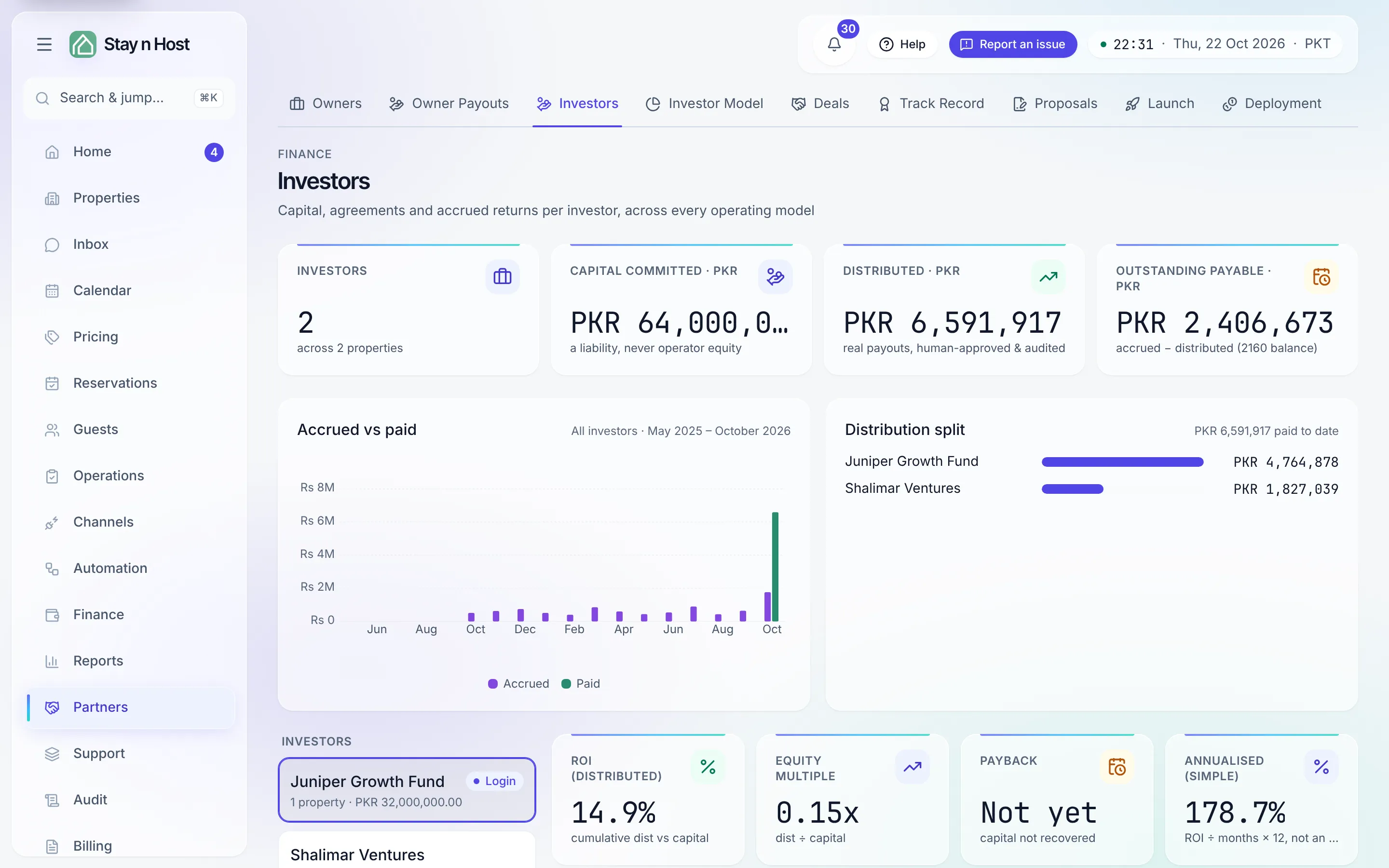
An investor appears here once a property’s Finance tab records an investment agreement - the agreement (pro-rata split, simultaneous split, or fixed return) is the source, this page is the ledger view over it.
Record capital in
Section titled “Record capital in”-
Click “Record capital” on the investor: the receiving account, the property whose pool the capital bought into, the amount, the date received, and a memo (e.g. “Tranche 2 of 3”).
-
It posts as a liability owed back to the investor - never as income. If the deal was scheduled in tranches, match this receipt to its tranche on the deal’s capital schedule.
Pay a distribution out
Section titled “Pay a distribution out”-
Click “Record payout”: the paying account, the amount (capped at the outstanding payable), and an optional bank reference. The request parks as Pending approval
- nothing moves yet.
-
Approve or Reject as a separate, recorded act (the person who requested it may approve it; both names are kept). Approval posts the disbursement; the row flips to Paid and appears on the Treasury ledger and in the investor’s portal, with a downloadable receipt.
Each investor’s card keeps score honestly: ROI measured on distributed money only, the equity multiple, payback (“Month N” or “Not yet”), and a simple annualized rate that’s labeled as such - not an IRR.
Share changes and the exit
Section titled “Share changes and the exit”- Unread share changes - when an investor’s holding changes, a written notice is issued and this card chases unconfirmed ones. The share already applies; the acknowledgment is a receipt, not an approval anyone waits on.
- Exit & buyback - Give notice records the exit: the investor keeps earning through their notice period, and the proposed buyback is priced on what the assets they funded are still worth (written-down furniture, refundable deposits, unconsumed advance rent). Approve the notice, then Pay it back - returning capital clears what was owed; it’s not an expense.
What’s next
Section titled “What’s next”- The investor’s own view: What the investor sees.
- The pipeline that promised this capital: From yes to deal.